Build on what we have learned. Leave room for what comes next.
We have been building e-commerce solutions since the early 2000s. Through those projects, we came to understand catalogues and orders, and the work behind them: customer agreements, inventory constraints and the everyday practices of the people doing the job.
One question kept coming up: how can digital tools evolve while preserving what already makes a business effective? That concern led us to begin working on Boutik in 2020.
The catalogue was the start of the conversation.
Our projects soon showed us that two companies selling similar products can serve their customers in very different ways. One has negotiated prices. Another prepares products to order. A third needs its representatives to reach the right customer records at the right moment.
Building a useful solution means understanding those differences. An interface can look complete while leaving important work in email threads or spreadsheets. We look at what happens before an order, during processing and after it is submitted. Those steps reveal the information people need and the decisions an application must support.
Preserve the work that still has value.
We have worked with different platforms and developed customizations for B2B requirements. Some adaptations and major migrations prompted us to think carefully about where business-specific logic belongs in an architecture. How could we add an important rule while keeping the rest of a solution able to evolve?
Continuity of investment became a design criterion. We have worked with some customers for roughly fifteen years, with applications that continue to develop alongside their businesses. Every situation is different. Those relationships remind us that technical decisions also affect the people who will use, support and maintain a solution over time.
Reuse experience while making room for differences.
We began by building tools, then reusable applications. Some of that work could benefit several businesses: common mechanisms did not need to be recreated for every project. We also needed a clear place for each company’s particular requirements, without allowing every adaptation to become entangled with everything else.
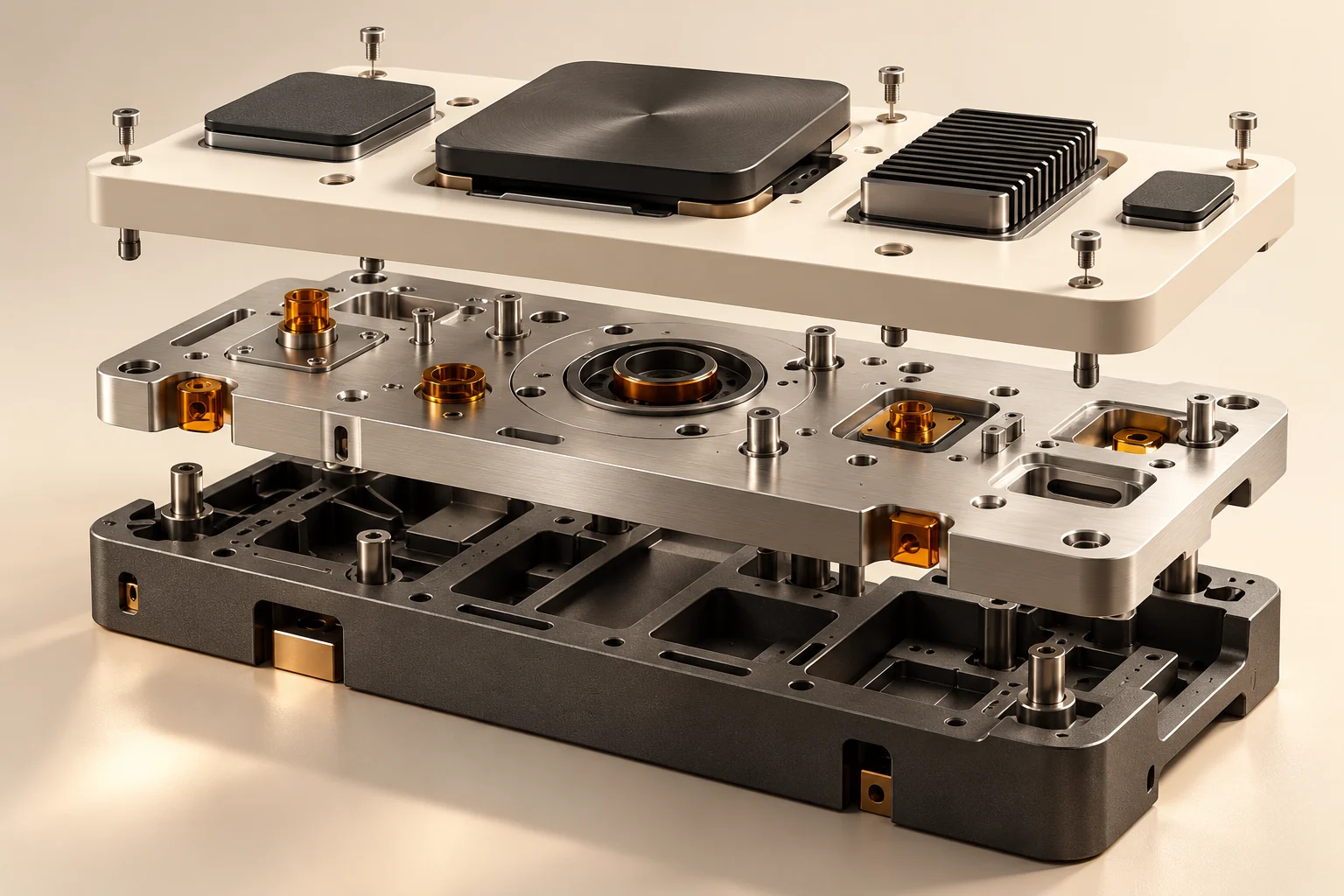
Boutik continues that approach. Its modular architecture separates common mechanisms, the adaptation to business-system data and the experience presented to users. This separation lets us work on a specific part while understanding its relationships with the whole. It still calls for design decisions, validation and ongoing maintenance.
Start with the systems that already run the business.
An ERP, or enterprise resource planning system, often holds essential parts of the commercial relationship: accounts, prices, orders, inventory and documents. Introducing another tool without accounting for that information can simply move work from one place to another.
That is why integration sits at the heart of Boutik. Whether the environment is recent or includes an older system, we examine the interfaces, access and data available. Exchanges are defined for each project. The aim is to make useful information and functions accessible to the right tools, with clear responsibilities for how they are used and maintained.
Commerce shaped the thinking. The foundation can serve other needs.
E-commerce informed our approach, but it does not define the limits of Boutik. A customer portal, a business application, a field tool or an automation project may also use this foundation, depending on the requirements and connections involved.
The same applies to projects using artificial intelligence. Their usefulness depends on accessible information, the rules that must be respected and the role of the people using them. We want to accommodate new uses without asking a company to specify every tool it may need in the future. That openness is a design goal, with each new use assessed on its own merits.
Begin with a situation worth improving.
A project starts with everyday work: a task that takes too long, a rule that current tools handle poorly or information that is difficult to find. Together, we define a first workflow, make it tangible and validate the decisions with the people involved.
That is also how we develop Boutik: begin with real needs, bring our experience together and build the next step with the people who understand the business. You do not need to arrive with a fully specified platform. A concrete situation gives us something useful to explore, question and improve.
Bring these to an initial conversation
✓ A task or workflow you would like to improve.
✓ The rules that make your business distinctive.
✓ The systems and applications we should consider.
✓ What you want to preserve in your current tools.